Inverter AC Gas Leakage Repair & Refill Charges in Karachi: 2026 Rate Guide (R32 vs R410A)

Quick Overview
It is peak summer in Karachi, your inverter AC is running all day, yet the room never feels properly cool. Then a technician glances at the outdoor unit and says the line every homeowner dreads: “Gas khatam ho gayi hai.” Before you agree to anything, here is what you should know. A full vacuum-and-recharge for a 1.5 ton inverter costs Rs. 8,500 to Rs. 11,000 in Karachi’s 2026 market — but a refill without fixing the leak is money straight down the drain, because sealed AC gas never “finishes” on its own. Worse, running your AC low on gas forces the compressor to work at full load nonstop, silently adding Rs. 7,500 to Rs. 11,000 to your monthly K-Electric bill. This guide gives you the real 2026 rates for R32 and R410A refills, leak detection charges, pressure readings you can verify yourself, and the scams to watch out for.
Which Gas Does Your AC Use? (R32 vs R410A vs R22)
Not all AC gas is the same, and the type decides both the refill price and the correct pressure readings. The easiest way to check is the sticker on your indoor unit or the user manual — it clearly mentions R32, R410A, or R22. Here is what each one means for you:
R32 (Most New Inverters)
FOUND IN: Almost all inverter ACs sold after 2020
Single-component gas, more energy efficient and eco-friendly. Runs at high pressure. Mildly flammable, so only trained technicians should handle it — never let anyone weld near a leaking unit.
R410A (Older Inverters)
FOUND IN: Inverter models from roughly 2012–2020
A blend of two gases, non-flammable and stable. Slightly costlier per refill and being phased down globally, but still widely available in Karachi markets.
R22 (Old Non-Inverters)
FOUND IN: Conventional non-inverter ACs only
Old single gas, now phased out worldwide. Refills are still available but supply is shrinking every year. If your unit uses R22, every refill gets harder to arrange.
Pressure Readings You Can Ask Your Technician to Show
A proper technician checks gas with a manifold gauge — two dials connected to your outdoor unit. You don’t need to master the tool, but knowing the correct numbers stops guesswork. Ask for a photo of the readings before and after the job:
| Gas Type | Running Pressure (AC ON) | Standing Pressure (AC OFF) |
|---|---|---|
| R32 | 110 – 120 PSI | 220 – 240 PSI |
| R410A | 120 – 130 PSI | 225 – 250 PSI |
| R22 | 60 – 70 PSI | 150 – 160 PSI |
Simple rule: if the running pressure is far below these ranges and the cooling is weak, the gas really is low. If the pressure is fine but cooling is poor, your problem is something else — usually choked filters, a dirty condenser, or a weak capacitor — and you need an AC inspection, not a refill.
AC Gas Refill Charges in Karachi (2026 Market Rates)
Below are the real going rates across Karachi in 2026 — from DHA and Clifton to Gulshan, Nazimabad, and Malir. A full vacuum-and-recharge means the old gas and moisture are pulled out completely and fresh gas is filled by weight. A top-up only adds a little gas on top, which is fine for minor seasonal loss but useless against a real leak:
| Service Type | Unit Capacity | Gas Type | Quantity Used | 2026 Rate (PKR) |
|---|---|---|---|---|
| Full Vacuum & Gas Recharge | 1.0 Ton Inverter | R32 / R410A | 700g – 900g | Rs. 7,000 – 8,500 |
| Full Vacuum & Gas Recharge | 1.5 Ton Inverter | R32 / R410A | 950g – 1,250g | Rs. 8,500 – 11,000 |
| Full Vacuum & Gas Recharge | 2.0 Ton Inverter | R32 / R410A | 1,300g – 1,600g | Rs. 11,500 – 14,000 |
| Partial Gas Top-Up | 1.0 – 1.5 Ton | R32 / R410A | 200g – 400g | Rs. 3,500 – 5,000 |
| Non-Inverter Full Refill | 1.5 Ton | R22 | 1,000g – 1,200g | Rs. 5,500 – 7,000 |
Rates move slightly with gas cylinder prices in the wholesale market and with peak summer demand in May–July. Want a quick number for your exact unit? Use our AC price estimator or ask on WhatsApp with your AC tonnage and gas type.
Leak Detection & Repair Labor Rates (2026)
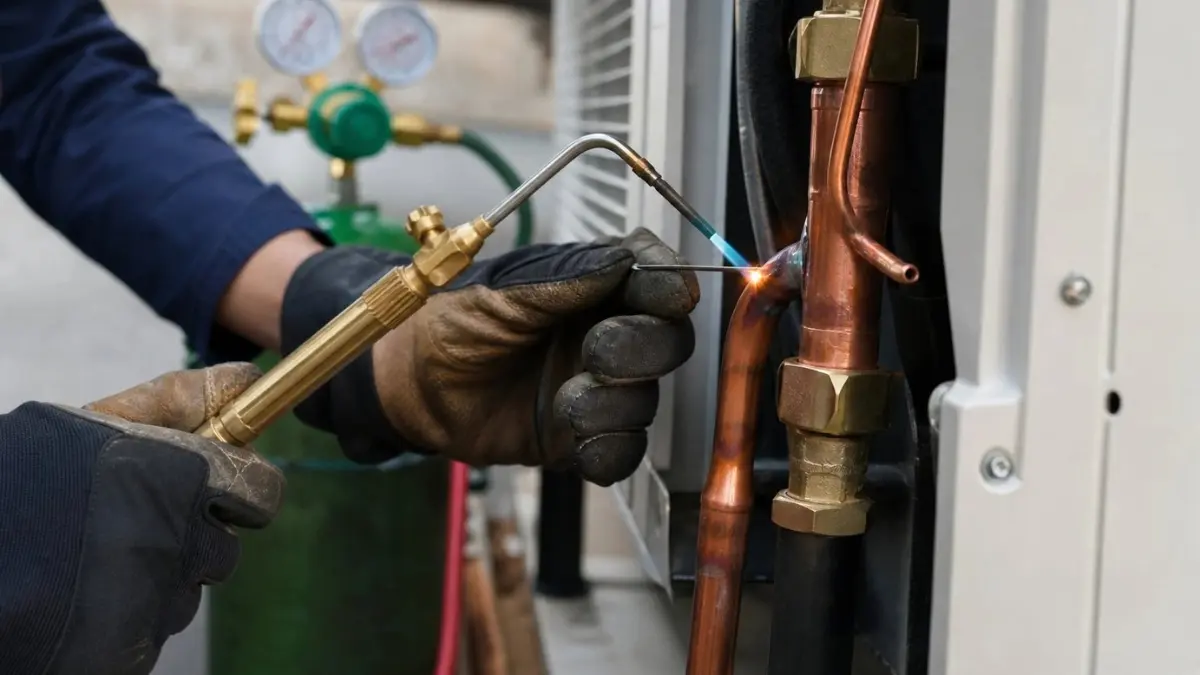
Here is the part most homeowners miss: the refill is the cheap half of the job — finding and fixing the leak is the real work. An AC is a sealed system. Gas never “finishes” like fuel; if it is low, it escaped from somewhere, and new gas will escape from the same hole. Most Karachi leaks happen at the copper flare joints (where pipes connect to indoor and outdoor units), followed by pinholes in the condenser or evaporator coils caused by vibration and coastal humidity.
| Leak Job | What It Involves | 2026 Labor Rate (PKR) |
|---|---|---|
| Nitrogen High-Pressure Leak Test | System pressurized to 350 PSI with nitrogen and held for 24 hours to confirm hidden leaks | Rs. 2,500 – 3,500 |
| Copper Coil Silver Brazing | Welding cracked evaporator/condenser coil joints, per joint | Rs. 1,800 – 2,800 |
| Flare Nut Redo + Brass Valve | Re-cutting pipe flares and replacing worn service valves (most common fix) | Rs. 1,200 – 1,800 |
| Master Chemical Service | Demounting indoor + outdoor units with full jet wash, per unit | Rs. 2,500 – 3,500 |
The nitrogen test is the gold standard — if a technician wants to refill without any leak check, that is your cue to get a second opinion. Many customers combine the leak repair with a master service, since the units are already opened and dusty coils hide small leaks. Our AC repair team in Karachi always pressure-tests before charging gas, so you pay for the refill only once.
How Gas Leakage Quietly Raises Your K-Electric Bill
This is the hidden cost nobody tells you about. An inverter AC saves electricity by slowing its compressor down once the room is cool — dropping to a gentle 2.5 to 4.5 amps in eco-mode. But when gas is low, the room never reaches the set temperature, so the compressor stays stuck at full speed, pulling 10 to 13 amps hour after hour. Your “inverter” starts consuming like an old non-inverter — or worse.
Think about that irony for a moment: delaying a one-time ~Rs. 10,000 refill-plus-repair can cost you nearly the same amount every single month in wasted electricity — while also overheating and shortening your compressor’s life. Check your slab on the official K-Electric tariff portal, then read our breakdown of the hidden reasons your electricity bill stays high — low AC gas is one of the biggest culprits on that list.
6 Signs Your AC Gas Is Actually Low
Before calling anyone, run this 2-minute check yourself. If two or more of these match, low gas is very likely:
- Weak cooling despite long running hours — the AC runs all afternoon but the room stays uncomfortable, especially in May–August heat.
- Ice or frost on the thin copper pipe — step outside and look at the pipes entering the outdoor unit. A white frosty coating on the thin pipe is the classic low-gas signature.
- Outdoor unit never switches off — a healthy inverter outdoor slows down and goes quiet; a low-gas one roars at full speed endlessly.
- Hissing sound near pipe joints — stand near the indoor and outdoor connections in a quiet moment. A faint hiss or bubbling means gas is actively escaping.
- Water dripping with poor airflow — ice forming on the indoor coil melts and drips, while cooling keeps dropping.
- Sudden jump in your KE bill — same usage pattern, but 100+ extra units compared to last summer month.
How a Proper Gas Refill Is Done (Step by Step)
A correct refill job takes 1.5 to 2.5 hours — not 20 minutes. If your technician finishes suspiciously fast, corners were cut. Here is the full process, in order:
- Step 1 — Confirm with readings: manifold gauge pressure, clamp-meter amps, and cooling difference between room air and outlet air (a healthy split cools outlet air by roughly 10–12°C).
- Step 2 — Find the leak: soap solution on joints for visible leaks; nitrogen pressurization for hidden ones.
- Step 3 — Repair it: silver brazing for coil cracks, fresh flares and brass valves for joint leaks.
- Step 4 — Nitrogen hold test: 350 PSI held up to 24 hours proves the system is truly sealed.
- Step 5 — Deep vacuum: a vacuum pump pulls out all air and moisture. Skipping this is the most common shortcut — moisture inside forms acid that eats the compressor from within.
- Step 6 — Charge by weight + final test: gas filled per the nameplate grams, then amps and cooling verified in front of you.
4 Gas Refill Scams to Avoid in Karachi
Gas work is where overcharging happens most, because you can’t see the gas. Protect yourself with these four checks:
- 1. The yearly top-up trap: “Gas har saal khatam hoti hai” is simply not true — a sealed system holds gas for years. If someone tops up your AC every summer without ever finding a leak, you’re renting gas instead of owning a repair. Demand a nitrogen test.
- 2. The no-vacuum refill: gas pumped straight in without vacuuming takes 20 minutes and feels cheaper — until moisture kills your compressor a season later. Always ask: “Vacuum pump lagaya?”
- 3. The overcharge: too much gas cools just as badly as too little, while pushing amps dangerously high. Correct charge is by weight (grams on the nameplate), never “andaza se.”
- 4. Full-refill billing for a top-up: you pay Rs. 10,000 for a “complete gas” but only get a 300g top-up worth Rs. 4,000. Counter it: ask the quantity in grams, and take before/after photos of the gauge yourself.
A trustworthy technician welcomes these questions — only the other kind gets uncomfortable. That is exactly why our AC gas refill service in Karachi shares gauge photos, gas quantity, and post-job amp readings on WhatsApp before you pay a rupee.
Frequently Asked Questions
How do I know my AC needs gas and not just a service?
Check three things: ice or frost on the thin outdoor copper pipe, an outdoor unit that never slows down, and a sudden K-Electric bill jump. If none of these are present and it’s been over 6 months since a service, get a master chemical service first (Rs. 2,500 – 3,500) — choked coils mimic low-gas symptoms and the fix costs far less than a refill.
Can I just top up the gas without finding the leak?
Only if the loss is tiny and the system holds pressure afterward. In most cases the same leak drains the new gas within weeks or months, and repeated top-ups let moisture in, which damages the compressor. A one-time nitrogen test (Rs. 2,500 – 3,500) plus repair is cheaper than refilling every season.
R32 vs R410A — which gas is better for my inverter AC?
R32 is the newer choice: slightly more efficient, lower global-warming impact, and usually cheaper per refill. R410A is older but proven and non-flammable. You cannot switch or mix them — always refill exactly what your indoor unit’s nameplate specifies, or the compressor warranty and performance both suffer.
How long should an AC gas refill last?
Years — an AC is a sealed system, so properly repaired and charged gas lasts 3–5 years or more. If your AC needs gas every summer, there is an active leak that was never fixed. That pattern alone is reason to call a technician who pressure-tests before charging.
Why do gas refill quotes in Karachi vary so much?
Because “gas refill” means different things to different shops: gas type and quantity (R32 vs R410A, grams filled), whether leak detection and nitrogen testing are included, whether deep vacuuming is done, and whether the gas is genuine branded refrigerant or cheap local stock. Always compare itemized quotes — gas quantity in grams, leak test included or not, and vacuum included or not.
AC Not Cooling? Get Gas Checked Before the Next Bill Shock
Send us your AC tonnage, gas type (check the indoor sticker), and your Karachi area. We’ll confirm the leak test, repair, and refill scope with a clear price — gauge photos and amp readings shared before you pay.
Message Pronto PK on WhatsApp